
Why Predatory Towing Is a Real Problem for Truck Drivers
You wake up in the middle of the night and instantly know something is wrong. Not because of a noise. Not because of a phone call. Because the truck moved.
Or worse, you walk outside and the truck is gone.
Not stolen. Towed.
Before you can fully process what happened, someone is demanding thousands of dollars just to put the truck back on the ground. For commercial drivers, predatory towing is not just frustrating. It can interrupt a federally required break, delay a load, create damage, cost real money, and turn an already stressful night into a major problem.
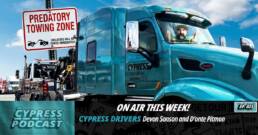
In Episode 23 of the Cypress Truck Lines Podcast, host Marcus Bridges sits down with Cypress drivers Devon Sonson and D’onte Pitmon to talk about their firsthand towing experiences. Both drivers own their mistakes. Both worked with dispatch to get the situation handled. And both came away with lessons that could save another driver money, stress, and sleepless nights.
Listen to This Episode
Listen wherever you get your podcasts, including Apple Podcasts, Spotify, Amazon Music, iHeartRadio, and Podchaser.
Episode Overview
This episode is about more than a bad parking decision. It is about what happens when truck parking is limited, drivers are tired, pressure is high, and people are looking for ways to take advantage of commercial drivers.
Marcus opens the episode by talking about the broader issue of predatory towing, parking shortages, cargo theft, and organized scams targeting the trucking industry. From there, Devon and D’onte walk through their own towing situations in detail.
Devon explains how he parked near a truck stop after struggling to find legal parking, only to wake up and find his truck already hooked to a tow truck. D’onte explains how he parked in a familiar industrial area near home, then came back to find the truck gone and initially feared it had been stolen.
The details are different, but the lesson is the same: do not assume a spot is safe just because other trucks are there. Do not ignore your gut. And when something goes wrong, call dispatch right away.
What You’ll Learn
- Why predatory towing is becoming a bigger concern for truck drivers
- How parking pressure can push drivers into risky decisions
- What Devon and D’onte learned from their towing experiences
- Why “other trucks are parked there” does not mean a spot is legal
- Why dispatch should be the first call when a towing situation happens
- How cargo theft and parking safety connect to driver awareness
- Why new drivers need to slow down and plan parking early
- Why your CDL is not just your license, it is your career
Predatory Towing Is Not Just a Parking Problem
Truck parking is one of the hardest daily challenges drivers face. When a driver is running out of hours, has already checked multiple truck stops, and is just trying to get parked for the night, a questionable spot can start to look good enough.
That is where risk enters the picture.
Devon’s story begins after picking up a load near Mount Holly. He was new, short on time, and trying to find a place to shut down. The first truck stop had no parking. The next one had no parking either. Outside the truck stop, he saw a line of trucks parked along the road. He assumed that meant it was acceptable overflow parking.
It was not.
A sign marking the private property line was there, but he missed it. Not long after he parked, he woke up to the truck moving. A tow truck had already hooked him. The driver told him it would cost thousands of dollars just to set the truck back down.
That is where the predatory side of the issue comes in. The situation may have started with a parking mistake, but the cost, pressure, timing, and lack of options made it much bigger than that.
Do Not Assume a Spot Is Safe Because Other Trucks Are There
One of the clearest lessons from this episode is that drivers cannot rely on what other drivers are doing.
Devon saw other trucks parked and assumed the spot was safe. D’onte saw trucks parked in an industrial area near home and thought the same thing. In both cases, the assumption created a problem.
That does not mean the drivers were careless. It means they were human. They were tired, trying to manage time, and making a decision under pressure. That is exactly the situation predatory towing operators and parking enforcement schemes can exploit.
The safer move is to verify the spot before shutting down. Check signs. Look for posted restrictions. Call the shipper or receiver if you are unsure. Ask dispatch if they know whether parking is allowed. If something does not feel right, keep looking or call for help.
A few extra minutes of checking can prevent hours of stress later.
Dispatch Is Your Biggest Advocate
Both Devon and D’onte make it clear that dispatch was the key to getting their situations handled.
Devon called night dispatch after the tow company demanded money to drop the truck. Dispatch helped manage the situation, communicate with leadership, and work through the next steps. He says dispatch did not pile on or make the situation worse. They helped him get through it.
D’onte had a different version of the same lesson. He first thought the truck had been stolen. Once he found out it had been towed, he contacted dispatch and they walked him through what information to gather, who needed to be contacted, and how to move forward.
That matters because a driver in the middle of a towing situation is usually tired, frustrated, embarrassed, stressed, or all of the above. Dispatch has the experience, contacts, and company support to help navigate the situation.
Calling dispatch is not admitting defeat. It is making the smartest move available.
Treat the Situation Like It Matters
One of Devon’s strongest pieces of advice is to treat a towing situation like something that could become legal or financial very quickly. Do not argue. Do not volunteer extra information. Do not try to negotiate everything on your own in the middle of the night.
Get dispatch involved immediately.
That does not mean drivers should be rude or uncooperative. It means they should slow down, protect themselves, and avoid saying something that makes the situation harder to resolve. When money, equipment, freight, and liability are all involved, the best thing a driver can do is get the right people on the phone.
This episode makes that point clearly: the driver is not alone. Cypress has people available to help, but they need to know what is happening as soon as possible.
Cargo Theft, Parking Safety, and Driver Awareness
Although the episode focuses mostly on towing, Marcus also brings cargo theft into the conversation because the two issues are connected by one major factor: parking.
Where a driver parks matters.
A poorly lit area, an unfamiliar lot, an isolated road, or a place that does not feel right can create risks beyond towing. Freight can be targeted. Equipment can be stolen. Drivers can be watched. Criminals know that tired drivers under pressure may make decisions they would not make earlier in the day.
Devon and D’onte both talk about using known truck stops, safer parking areas, familiar locations, and places where commercial vehicles are clearly welcome. D’onte also talks about teaching trainees to plan ahead, call when needed, and verify parking before they arrive.
That advice is especially important for new drivers. The instinct to know whether a spot feels wrong comes with time, but stories like these help drivers build that awareness faster.
Your License Is Your Career
Devon says something near the end of the episode that deserves to be repeated: your license is now officially your career.
A CDL is not just a card in your wallet. It is how a driver earns a living. It is tied to every decision made behind the wheel, even outside the truck. That awareness matters because trucking is a career where small choices can become big consequences quickly.
Where you park matters. How you respond under pressure matters. Whether you rush or slow down matters. Whether you call dispatch or try to handle it alone matters.
D’onte builds on that same point with a simple reminder: patience is a virtue. Take your time. Be safe. Get back home to your family and help everyone else on the road get back home to theirs.
We Are Not Hauling Body Parts
Marcus closes the episode by returning to one of the core Cypress philosophies: we are not hauling body parts.
The load matters. The schedule matters. The customer matters. But the driver in the seat matters more.
That philosophy applies to predatory towing, parking, cargo theft, trip planning, and every other stressful part of the job. When the pressure starts building, the answer is not to rush harder. The answer is to slow down, take your time, communicate, and do the job the right way.
A tired driver under pressure is vulnerable. A prepared driver who calls dispatch, trusts their instincts, and refuses to rush is much harder to take advantage of.
That is the real lesson of Episode 23.
Frequently Asked Questions
What is predatory towing in trucking?
Predatory towing refers to towing practices that target drivers with excessive fees, unclear parking enforcement, aggressive towing, booting, or other tactics that create expensive and stressful situations. In trucking, these situations can involve commercial vehicles, freight, equipment, and large towing bills.
What should a truck driver do if their truck gets towed?
A truck driver should contact dispatch immediately, stay calm, avoid arguing, and gather clear information about where the truck was towed, who towed it, what paperwork is being requested, and what fees are being claimed. Drivers should not try to manage the situation alone if company equipment or freight is involved.
Why is truck parking such a big issue?
Truck parking is a major issue because drivers often struggle to find legal, safe parking before their hours run out. When truck stops are full and time is limited, drivers may feel pressured to park in questionable areas, which can increase the risk of towing, cargo theft, or safety problems.
How can drivers avoid predatory towing situations?
Drivers can reduce the risk by planning parking earlier, using known truck stops and approved parking areas, checking signs carefully, calling shippers or receivers when unsure, asking dispatch for guidance, and avoiding areas that feel unsafe or unclear. Drivers should not assume a spot is legal just because other trucks are parked there.
Why should drivers call dispatch first?
Dispatch can help protect the driver, the truck, the load, and the company. Dispatchers know who to contact, what information is needed, and how to guide the driver through the situation. A tired driver dealing with a towing company in the middle of the night should not have to handle it alone.
What is the biggest lesson from this episode?
The biggest lesson is to slow down and trust your instincts. If a parking spot does not feel right, do not park there without checking. If something happens, call dispatch. If pressure starts building, take your time. Your CDL is your career, and protecting it starts with the small decisions.
Drive with a Company That Has Your Back
if you are looking for a flatbed trucking career with real support, strong communication, and a team that understands the pressure drivers face on the road, Cypress Truck Lines may be the right fit.
Learn more about driver safety at Cypress Truck Lines, explore entry-level CDL jobs, or visit our OTR trucking jobs page if you are interested in long-haul flatbed driving.
Don’t have your CDL yet? Cypress can help you get started through Cypress CDL School.
Questions? Call 1-800-545-1351 to speak with a recruiter.